How to Understand Bill Gates's AI Warning About Catastrophic Risk and Weak Regulation
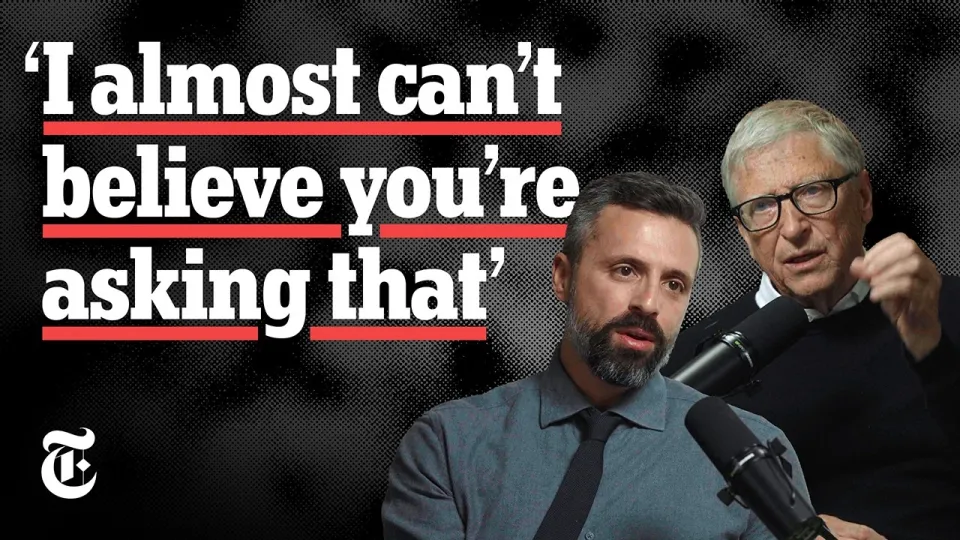
Video: Bill Gates: A.I. ‘Makes Nuclear Weapons Look Like Nothing’ | The Ezra Klein Show
You can order the same kind of articles for your own video to boost it on YouTube and Google. Just message the Telegram bot @sat_sit_bot. It writes articles around your video, embeds the video and publishes them on popular niche websites (no ads). Free trial — 50 articles.
· based on the channel The Ezra Klein Show
Bill Gates's AI warning is best understood as a claim about speed and governance, not about robot uprisings: he argues that artificial intelligence is advancing faster than the institutions meant to contain it, that the next few years will bring catastrophic cyberattacks and bio-terrorism attempts, and that letting the industry police itself is "insane." The full conversation with Ezra Klein, including the transcript, is available through The Ezra Klein Show episode page.
What Gates actually claims about AI risk
Gates's position is that AI is the most dangerous technology humans have ever approached, and that the comparison to nuclear weapons understates the problem rather than overstating it. Nuclear arsenals are expensive, visible, and controlled by a handful of states; frontier AI models are cheap to train, easy to copy, and run on commodity hardware. That asymmetry is the core of his argument.
His forecast is concrete rather than abstract:
- Cyber offense. AI lowers the cost of finding and exploiting software vulnerabilities, shifting the advantage toward attackers against both companies and critical infrastructure.
- Bio-terrorism. Models that help design defenses can also lower barriers for someone trying to engineer a pathogen, which is why Gates treats biological risk as a threshold issue rather than a distant hypothetical.
- Speed of onset. He frames these as risks of the coming years, not of some far-off generation of machines — the gap between capability and countermeasure is what worries him.
Why self-regulation fails in his account
Gates rejects the idea that AI companies can be trusted to restrain themselves, and he is unusually blunt about it: he calls that position insane. The reasoning is structural, not personal. Firms compete on capability, investors reward speed, and any company that pauses unilaterally hands advantage to rivals. Voluntary commitments therefore erode exactly when risk rises.
He is equally dismissive of relying on courts. Asked whether liability and lawsuits could discipline the industry, his response was close to disbelief: a lawsuit is no remedy for an event that kills tens of millions of people. Ex post legal accountability cannot substitute for ex ante limits when the harm is irreversible.
What he points toward instead is government-set thresholds — conditions under which training runs, deployments, or specific capabilities are paused or require approval. The policy question is not whether to regulate but where to draw the line and who has the authority to enforce it.
The race with China and the safety trade-off
Gates treats the US–China competition as the main reason safety arguments lose politically. Any slowdown by one country looks like a gift to the other, so calls for caution get reframed as unilateral disarmament. He does not resolve this tension so much as insist that it be named: a race frame rewards the least cautious participant.
That is why his emphasis lands on thresholds that apply to capabilities rather than to companies, and on coordination between the small number of labs able to build frontier systems. The same logic explains why he thinks the current mix of voluntary pledges and scattered national rules is inadequate to the pace of development.
Jobs, inequality, and taxing AI labor
On the economy, Gates expects AI to displace labor at a scale that existing safety nets were not designed for, and he is skeptical of the comfortable assumption that new jobs appear automatically. His proposals sketch a different arrangement:
- Tax AI labor. If machines do work that humans were paid for, the tax base has to follow the work rather than the worker.
- A no-scarcity job market. He explores what employment looks like when goods and services become dramatically cheaper to produce.
- "Human reserved" jobs. Some roles — care, teaching, certain public services — could be designated as human-only, both to preserve dignity and to keep demand for people.
- Inequality as a global problem. He notes that inequity persists partly because of distance, and that AI could widen the gap between rich and poor countries unless access is deliberately spread.
He also flags language access as a genuine upside: AI translation and tutoring can extend services to communities that never had them.
Education, children, and the learning-loss problem
Gates sees AI tutoring as one of the technology's clearest benefits, particularly where qualified teachers are scarce. But he pairs that optimism with a warning about rich countries, where pandemic-era learning loss has not been recovered and where AI can just as easily become a shortcut that erodes thinking as a tool that builds it.
His practical position is that children need specific rules: age-appropriate safeguards, limits on data collection, and clear expectations for how AI is used in classrooms. That is a narrower regulatory question than frontier-model safety, and one where he thinks agreement is achievable faster.
The questions viewers keep raising
Three objections recur among people who watch the interview. The first is about credibility: a Microsoft co-founder warning about AI invites the charge of self-interest, given Microsoft's partnership with OpenAI. Gates's answer is structural — he is describing incentives that apply to every lab, including the ones he is closest to.
The second is about temperament. Viewers note how visibly unsettled he appears, and how he pushes back on Klein's framing rather than softening it. The discomfort is the argument: the person with the most to gain from optimism is describing the situation as worse than the interviewer does.
The third is about capitalism itself. If profit incentives drive capability races, can markets self-correct? Gates's view is that they cannot, at least not before irreversible harm — which is why he keeps returning to government action rather than corporate conscience. The same skepticism applies to the argument, associated with Nvidia's Jensen Huang, that commercial incentives will naturally produce safety remedies.
Useful links
- Full transcript of the Bill Gates conversation on The Ezra Klein Show
- Book recommendations from guests of The Ezra Klein Show
The bottom line
Gates's message is that AI capability is outrunning the institutions that would have to catch it, and that the window for setting thresholds is now rather than after the first catastrophe. His proposals — capability-based regulation, taxes on AI labor, human-reserved roles, and child-safety rules — are less a blueprint than a demand that governments stop treating the industry as self-policing. The discomfort in the interview is the point: the most enthusiastic technologist in the room is the one asking for limits. For the full argument in his own words, read the transcript on The Ezra Klein Show, the channel behind this analysis.
Key takeaways
- Gates calls AI the most dangerous technology humanity has approached, saying it makes nuclear weapons look like nothing.
- He expects catastrophic cyberattacks and bio-terrorism within years unless governments set hard thresholds.
- Industry self-regulation he calls "insane"; liability lawsuits are no answer to a weapon that could kill 100 million.
- The Gates Foundation will spend down roughly $200 billion over two decades, with AI-driven inequality as a new priority.
- He warns of mass job loss and proposes taxing AI labor and reserving some jobs for humans.
Source: Bill Gates: A.I. ‘Makes Nuclear Weapons Look Like Nothing’ | The Ezra Klein Show · Markdown version
Questions & answers
Why does Bill Gates say AI makes nuclear weapons look like nothing?
Because nuclear weapons are costly, visible, and controlled by a few states, while frontier AI is cheap to replicate and hard to monitor. Gates argues the same models that help defend against cyber and biological threats can be turned to attack, and the barrier to misuse is far lower than for any previous weapons technology.
What does Gates propose instead of industry self-regulation?
He wants governments to set capability thresholds that trigger pauses or require approval before deployment, rather than relying on voluntary corporate pledges. He also dismisses liability lawsuits as a remedy, arguing that courts cannot undo a catastrophic event after the fact.
How would taxing AI labor work in his framing?
The idea is that if machines perform work that humans were previously paid for, the tax base should follow the work rather than the worker. Gates pairs this with exploring a no-scarcity job market and designating certain care and public-service roles as reserved for humans.
Does Gates see any benefits from AI?
Yes. He highlights AI tutoring in places with few qualified teachers, translation that extends services to underserved languages, and potential gains in health and development. His concern is that these benefits arrive alongside risks that current policy is not prepared to manage.